Recommended Search Tool
TruthFinder
★★★★★
TruthFinder gives you instant access to criminal records, court filings, arrest records, address history, and more — pulling from millions of public databases in real time.
Search Public Records on TruthFinder
Sponsored Search — Results from all US public record databases
TruthFinder.com — Affiliate link, commission earned if you subscribe.
TruthFinder.com — Affiliate link, commission earned if you subscribe.

Introduction
Looking for Nevada public records? We make your search so much easier, by putting together information about the sites you will need to find birth certificates, criminal histories, drivers’ licenses, marriage certificates, and other Nevada public records. We will show you where to find free Nevada public records, saving you time and money as you track down publicly available information. We also explain the various types of public records, to help you determine what you need and where to find it. There are many reasons that people give for running a background check, but they all come down to wanting more information. Employers may run official background checks to verify the identity of the person that they are hiring and make sure that they do not have anything troubling in their background. Landlords may run background checks to look for a criminal history and to examine creditworthiness. However, many people run unofficial background checks just to get more information about the people in their lives, whether it is a prospective new love or the parents of a child’s friend. Sometimes background checks are not really checking on a background, at all, but are a tool to help locate a lost relative or the love that got away. You might even need to run a background check on yourself to find the documents you need for applications or to access benefits or programs. Another use for Nevada public records can be to help you if you are involved in legal proceedings. Whether you are anticipating a criminal court case or trying to settle a civil dispute such as a divorce or settling a will or estate, public information can help you with your issue. Before you start your public records search, it may be helpful to know what a public record is. Public records refer to any records, written or otherwise, created by a public agency in the course of business. This can include many internal documents that are of little use to the general public, but the term is often used to describe the kinds of records that the government keeps on people. Whatever type of public record you need, there are laws known as Sunshine Laws, that require governments to share many of their public records for free or for nominal fees. This handy how-to will show you how to access Nevada public records.
Freedom of Information Act
Some people would argue that without transparency, a free society is impossible. In fact, transparency was so critical to our Founding Fathers that the Freedom of the Press was addressed in the very first amendment in the Bill of Rights. However, ensuring that transparency was historically difficult. The Federal Freedom of Information Act and similar state laws help ensure that citizens will have access to public documents. The government has to balance the public’s interest in transparency with the individual’s right to privacy. In Nevada, the result is that not all public records are publicly available. The state has categories of information that are not released or may only be released to people who can prove an interest in the information. Nevada’s Public Records Law can be found in the Nevada Revised Statutes. While many people think of public records as a way to ensure accountability in public life, they also offer a surprising glimpse into private life. Public records can provide information on private activities that become part of the public record including births, deaths, marriages, divorces, and lawsuits. In addition, public records can provide information on events that many people like to try to keep hidden, such as criminal behavior. Public Records Are Available at All Levels: Federal, State, and Local While people talk about the government like it is one entity, the reality is that government exists at local, state, and federal levels. Depending on the location, local government might also be multiple levels including counties and municipalities. Each part of the government has its own public records. In fact, most public records are actually recorded and maintained at the local level. This includes vital statistics, property records, and even criminal records, though many states consolidate that information in state-level databases. Surprisingly, the public records people usually seek are held at the local level. Most states, including Nevada, handles drivers’ licenses at the state level, not the local level. Tracking down public records can feel a little daunting since they are at so many levels. Our guide will help you find the links to the sites you need to find Nevada public records.Free Nevada Public Records
If you are like most people, you think of some type of written data when you think of public information. While this accurately describes most of the public information that people normally access, public records actually include any type of record a public agency might be required to keep. This can include sound files, maps, sonar readings, multimedia files, and photographs. In addition to actual recorded records, what happens in a government proceeding is also part of the public record. This means that many places require that governments make many of their meetings and proceedings public. In Nevada, access to these meetings is covered by Nevada’s Open Meetings Law. Access to public meetings can help people see what it occurring at their local government level and may even facilitate participation in those meetings. One of the most common uses of public information is to find out or locate private people. People also use public information to get information about themselves. Public information can help you locate death certificates, birth certificates, marriage certificates, and divorces that you may need to provide for various types of applications. An additional way to find out more information about a person is to look at their legal history. Both civil and criminal legal histories can provide insights into people, including marriages, whether they have any children, divorces, judgments against them, and criminal history, including any incarcerations in federal, state, or local jails or prisons. One of the more familiar types of public records is the vital record. Vital records are records that keep track of important life events. Different states label different types of records as vital records. Birth and death certificates are reliably considered vital records, and most states consider marriage certificates to be vital records, as well. In some states, divorce records and adoption records are also vital records. Some vital records are not publicly available because they contain private information. Other vital records may only be available in official format if can show that you are the person in the record of related to the person in the record. Vital records are important because they may be used to obtain identification, get a driver’s license, get a passport, get a visa, or even enroll in school.
You can also look up information about parcels of property by looking up property records. They are generally broken into two types: property records and property tax records. This can give you information about who own a property, the value of the property, and whether there are any taxes on the property.
Examples of Free Public Records
One of the more familiar types of public records is the vital record. Vital records are records that keep track of important life events. Different states label different types of records as vital records. Birth and death certificates are reliably considered vital records, and most states consider marriage certificates to be vital records, as well. In some states, divorce records and adoption records are also vital records. Some vital records are not publicly available because they contain private information. Other vital records may only be available in official format if can show that you are the person in the record of related to the person in the record. Vital records are important because they may be used to obtain identification, get a driver’s license, get a passport, get a visa, or even enroll in school.
You can also look up information about parcels of property by looking up property records. They are generally broken into two types: property records and property tax records. This can give you information about who own a property, the value of the property, and whether there are any taxes on the property.
Examples of Free Public Records
- Property records—these records describe parcels of land, name the owners, may provide information about mortgages and liens, and can provide tax information.
- Court records—you may be able to search these records to see if a person has been the plaintiff or a defendant in a civil suit, as well as whether they have ever been a criminal trial defendant.
- Arrest records—these records may reveal whether or not someone has been arrested, charged with a crime, or convicted of a crime. The details in an arrest record may vary according to jurisdiction.
- Sentencing records—once a person has been convicted, it is easy to find out what sentence a person has received as well as to look at how judges treat defendants in their courtroom.
- Prison/Inmate records—these records can help people find out if a person is an inmate in a prison or jail and they exist at state, federal, and local levels. Most of this information is available, but juvenile offenders usually have sealed records.
- Missing person’s databases—one of the most interesting and helpful sources of public information, missing person’s databases allow for the reporting of missing people to help increase the likelihood that they will be found.
- Public safety records—a bit of a catch-all category that can vary by state, this refers to databases engaged in helping improve public safety. Sex offender registries are a good example of this type of record.
- Birth certificates—In all states, there are designated government offices that keep track of birth certificates, though it is often handled on a local level. They are important because people often need copies of their birth certificates in order to enroll in school, get picture identification, get passports, or even get marriage certificates.
- Death certificates—Death certificates are the official records of one’s death and they may be needed by survivors to close a person’s estate.
- Marriage and Divorce Records—Usually marriage certificates are kept in some type of state or local registry. Some states have similar registries for divorce records, while others require people to look at the courts where the divorces were granted in order to find those records. People may need marriage certificates to prove eligibility for benefits. In the world of online dating, many people also look at marriage and divorce records to make sure potential partners are single.
- Unclaimed property records—All states maintain databases of unclaimed property, which are designed to help reunite people with money that they forgot they had.
Nevada Background Checks
People think of different things when they think of the term “background check” and there is some uncertainty whether a background check is the same as a criminal background check. Basically, a background check involves exploring a person’s public records to gather information about them. The type of information sought helps determine the direction of the search. People may use them on a casual basis to find out more about social relationships or to help make business decisions. It is important to understand that a group of federal laws impacts what type of background searches can be used in specific-decision making circumstances like employment, lending, and entering in a rental relationship. There may also be state and local laws governing the use of public records. You may have to get consent from the person being searched if using the results of a background check in an official decision-making capacity. The biggest concern is probably the individual right to privacy, which is protected by federal law and Nevada state law. The right to privacy not only protects some public records from release, but can also require the withholding of certain private information, usually identifiers like social security numbers, from public records. However, no one should feel like the public record protects people from the release of any potentially damaging information. Criminal records, civil court records, public safety databases, and other public records can provide information that you would rather people not learn about you. For Employers or Landlords in Nevada It is important for employers and landlords everywhere to understand how the Fair Credit Reporting Act impacts the use of information from background checks in the decision-making process. If you have questions about whether your use of a background check is in compliance with the FCRA or any local Nevada laws, you should consult an attorney prior to conducting that background check. When used properly, background checks are a good way to gather information about people. It can also be an important step in a safety-process, though no one should ever assume that even a thorough background check can reveal everything about a person. One thing that background checks do frequently reveal is criminal history. Is the subject of your search a convicted criminal? What was the crime of conviction? Does the criminal history show a different crime when the defendant was charged? With more than 10% of all adults in the U.S. convicted of a felony, it is not realistic to suggest that a criminal history should make someone unemployable, but knowing what someone’s criminal history is can help an employer make educated decisions about whether they are an appropriate fit for certain positions. While this information may be easily available, it is important to always keep in mind that people are governed by law in how they can use background check information. In fact, some things like sex offender registries specifically prohibit harassment. However, people can generally use properly obtained information as part of a decision-making process. Do not get lulled into believing that a clean criminal history means a person has no history of wrongdoing. You also want to look at someone’s history of civil lawsuits, which can highlight allegations of wrongdoing that did not rise to a criminal level. Reasons for Background Checks Tenant Rights. Many people realize that landlords often run criminal background checks on prospective tenants, but tenants can also run background checks on prospective landlords. This can provide you with the information you need to know if you want to live in a house associated with a particular person. These background checks generally focus on criminal history and whether the landlord has a history of civil legal disputes with former tenants. Online dating safety. If you are dating online, it can be difficult to determine whether someone is too-good-to-be-true. A background check cannot tell you all of the information that you may need to know about a potential partner, but it is a great place to start to find out or verify information about criminal history, age, marital status, and whether someone has kids. Healthcare and Education. You often need your own public records to access services such as healthcare or education. Knowing where to find them can simplify that process.
College and University. Colleges and universities may require proof of identification in order to enroll in the school and may require certain documents for financial aid and scholarship eligibility.
Outsourcing and Hiring Contractors. Many people work with or for us without being actual employees. You can protect yourself by looking into their backgrounds, but how you use that information and the sources you use for it are probably governed by any applicable laws covering how employers can use background checks.
Childcare and Eldercare. Knowing who is with your family is an important priority. Even if you are using a reputable agency, you may want your own background check for peace of mind. Just make sure you are following all applicable laws.
Long Lost Loved Ones. Finding a missing family member or a lost love is another great use of public records.
Research. In addition to all of the above-listed reasons to run background checks, Nevada’s free public records can be great for anyone doing general research.
FCRA-Compliant Background Checks
The Fair Credit Reporting Act (FCRA) specifies how some people, generally those in business relationships with the person being investigated, can use background checks and may even limit who can perform those background checks.
We encourage anyone with questions about whether the FCRA applies to their intended use of a background check to consult the law and, if necessary, consult with an attorney, before using a background check service.
Under the FCRA, people are generally still allowed to look into a person’s background, but they have to follow certain steps to allow what they find to guide their decision-making process.
In addition, it is important to realize that you cannot insulate yourself from FCRA rules by using a third party to run your background check. You want to make sure any company or service you use is using FCRA-compliant techniques.
What Can My Employers Find Out About Me?
Are you in the market for a new job? If so, we strongly suggest you run a background check on your own name. It will help you find out what kind of information is available about you.
While prospective employers may not be allowed to use some data that is publicly available, it can never hurt to be prepared for their questions.
Why Are Public Records in Nevada Free?
The State of Nevada has a goal of transparency, which means that tax dollars support making public records available for free or at a low cost.
If a fee is charged for public records, the fees are supposed to be reasonable and proportionate to the time and expense involved in the state collecting and getting that information to you.
How Can I Find….
This guide will help you find the links you need to access Nevada public records.
Public Records Related to Criminal History
Healthcare and Education. You often need your own public records to access services such as healthcare or education. Knowing where to find them can simplify that process.
College and University. Colleges and universities may require proof of identification in order to enroll in the school and may require certain documents for financial aid and scholarship eligibility.
Outsourcing and Hiring Contractors. Many people work with or for us without being actual employees. You can protect yourself by looking into their backgrounds, but how you use that information and the sources you use for it are probably governed by any applicable laws covering how employers can use background checks.
Childcare and Eldercare. Knowing who is with your family is an important priority. Even if you are using a reputable agency, you may want your own background check for peace of mind. Just make sure you are following all applicable laws.
Long Lost Loved Ones. Finding a missing family member or a lost love is another great use of public records.
Research. In addition to all of the above-listed reasons to run background checks, Nevada’s free public records can be great for anyone doing general research.
FCRA-Compliant Background Checks
The Fair Credit Reporting Act (FCRA) specifies how some people, generally those in business relationships with the person being investigated, can use background checks and may even limit who can perform those background checks.
We encourage anyone with questions about whether the FCRA applies to their intended use of a background check to consult the law and, if necessary, consult with an attorney, before using a background check service.
Under the FCRA, people are generally still allowed to look into a person’s background, but they have to follow certain steps to allow what they find to guide their decision-making process.
In addition, it is important to realize that you cannot insulate yourself from FCRA rules by using a third party to run your background check. You want to make sure any company or service you use is using FCRA-compliant techniques.
What Can My Employers Find Out About Me?
Are you in the market for a new job? If so, we strongly suggest you run a background check on your own name. It will help you find out what kind of information is available about you.
While prospective employers may not be allowed to use some data that is publicly available, it can never hurt to be prepared for their questions.
Why Are Public Records in Nevada Free?
The State of Nevada has a goal of transparency, which means that tax dollars support making public records available for free or at a low cost.
If a fee is charged for public records, the fees are supposed to be reasonable and proportionate to the time and expense involved in the state collecting and getting that information to you.
How Can I Find….
This guide will help you find the links you need to access Nevada public records.
Public Records Related to Criminal History
Nevada Court Records
You can find out detailed information about someone’s civil and criminal legal disputes by examining court records. In Nevada, you can access much of this information on the Nevada Supreme Court’s case search portal. For case decisions at non-appellate levels, you have to contact the court that entered the decision. Find the contact information for these courts. There may be printing fees associated with obtaining court records. It is important to note that not all decisions will be available. A judge may routinely seal certain types of cases, select cases to seal, or redact information from a case.Nevada Driving Records
The Nevada Department of Motor Vehicles handles driving records and driver’s licenses as well as vehicle registration and license plates. You can obtain your own driver history for employment or insurance purposes . You cannot obtain anyone else’s driving record.Nevada Inmate Search / Criminal Records
There are more correctional facilities than colleges in the United States. If someone is locked up, they could be in a state, local, or federal prison or jail. Therefore, finding them can be a real challenge. If an inmate is detained by the Nevada Department of Corrections, you can use their inmate locator service to help find the inmate. If you are looking for information about a person who is detained in a local jail facility, you will want to contact the local office, usually a Sheriff’s Office, in charge of that jail. Inmates in federal facilities will be available through their locator services. If you want information about an inmate’s record while incarcerated, including things like sentence length and behavior while detained, you can contact the Nevada Department of Corrections. You can use the inmate search function to find out contact information for inmates, which can help you send letters, sign up for phone calls or visits, find out how to deposit money on inmate accounts, and related services. If you have been a victim of a crime by an offender, you may be able to sign up to be notified if the inmate is being released or transferred. The Nevada Department of Public Safety is responsible for processing criminal background checks for the state.Nevada Missing Persons Records
While some states maintain comprehensive statewide missing-person’s databases, Las Vegas does not have an official one. However, the city of Las Vegas maintains a missing persons database, and it may help you find information: Nevada also works with the nationwide NAMUS directory.Nevada Sex Offender Registry
Nevada has a sex offender registry: The sex offender registry is a great way to find out if people have been convicted of certain sex offenses, but not all people who commit sex offenses are on the registry. Search the Nevada State Sex Offender Registry.Nevada Property Records
In most states, including Nevada, property records are maintained on a local basis. To find property records, you need to look at the county property records. Clark County is the largest county in Nevada and you can find the Clark County property tax rolls. For more detailed information about property, you want to look at county deed records. Here is a list of Nevada counties. You want to look at the county level for property information.Nevada Unclaimed Money
People often have money in accounts that they forget about. After a statutory period of time, this money becomes part of the state’s unclaimed money fund. People can look at the unclaimed money registry to see if they have any funds. This money could be from refunds, deposits, bank accounts, and other sources of money.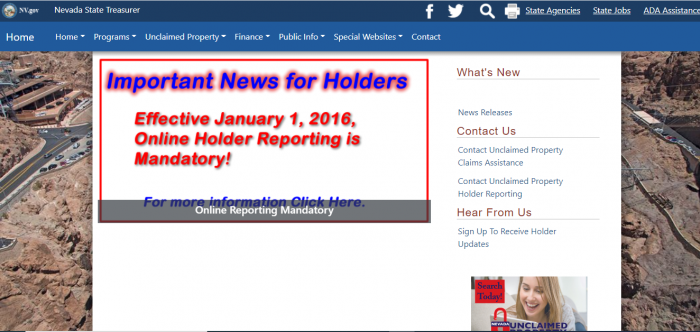 In Nevada, the Nevada State Treasurer manages the a, the Department of the Treasury’s Unclaimed Property Division manages the Unclaimed Property Database. You can search it by your name to see if you have any unclaimed property.
Nevada Vital Records
One of the most popular uses of Nevada public records is to find vital records. In Nevada, the Nevada Department of Health and Human Services handles its vital records. To get birth or death records, you can request them from their website. However, these records are not available to all people; you have to prove that you are the person named in the record or have a legitimate While these records may be searchable for all people, because copies of these records can be used to prove identity or get benefits, they are generally only available to either the person named in the document or an interested party.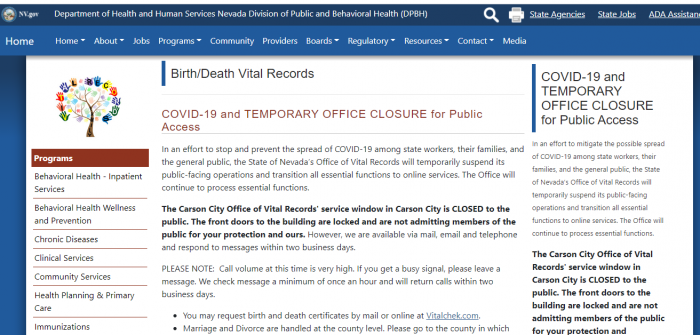 The Nevada Department of Health and Human Services Vital Records Division handles vital records requests.
Reasons for Using Vital Records
People need vital records for a variety of reasons. Birth certificates are necessary to get identification, secure passports, get visas, and for things like school enrollment and professional licenses.
You may need someone else’s vital records as well. Birth certificates and marriage certificates can help prove identity or relationships. You may also need a death certificate to help get death benefits or wind up an estate.
Another reason to use vital records is to do genealogy or ancestry research.
The Nevada Department of Health and Human Services Vital Records Division handles vital records requests.
Reasons for Using Vital Records
People need vital records for a variety of reasons. Birth certificates are necessary to get identification, secure passports, get visas, and for things like school enrollment and professional licenses.
You may need someone else’s vital records as well. Birth certificates and marriage certificates can help prove identity or relationships. You may also need a death certificate to help get death benefits or wind up an estate.
Another reason to use vital records is to do genealogy or ancestry research.
Conclusion
Searching public records can be time-consuming, but our guide is designed to help you streamline the process. Using it, you should be able to find free and easy-to-search public records for the state of Nevada. '
Search Public Records