Recommended Search Tool
TruthFinder
★★★★★
TruthFinder gives you instant access to criminal records, court filings, arrest records, address history, and more — pulling from millions of public databases in real time.
Search Public Records on TruthFinder
Sponsored Search — Results from all US public record databases
TruthFinder.com — Affiliate link, commission earned if you subscribe.
TruthFinder.com — Affiliate link, commission earned if you subscribe.

Looking for Public Records in Connecticut
Different government agencies maintain their own records in Connecticut. Thankfully, the state of Connecticut has recently centralized many of their public records databases to make it easier for you to find what you are seeking. Still, when you first begin looking for Connecticut public records, it helps to know more about how public records work in Connecticut and what laws are in place to ensure your ability to access those records. You also need to know how much it might cost to receive a copy of the records, and how to make sure you have a successful search. Some records will be maintained at the state level, but you may also need to contact municipalities in Connecticut for some information, such as property records. In some cases, there will be a nominal fee for accessing records, especially when you want a physical copy. You may also need to provide proper identification or credentials for accessing some types of public records.What Are Public Records in Connecticut?
Public records include everything from court proceedings to criminal records. Proceedings of government such as minutes from public meetings or state legislative acts will be considered public records. You have the right to access information like this, with freedom of information being the cornerstone of a democracy. Public records also include birth, death, and marriage records from the state of Connecticut, as well as will and probate records. Criminal records, arrest records, court records, and inmate records are also public records you can search.Public Records Laws in Connecticut
All states guarantee your freedom to access information because of federal legislation like the Freedom of Information Act, 5 U.S.C. § 552. The United States Department of Justice and the State Department both ensure that citizens have access to information because a democracy cannot function well without transparency.
However, there are some important exceptions to the Freedom of Information Act, but generally you are permitted to access any public records.
Exceptions include any information that might threaten national security or infringe on the rights of others.
The following are the main exceptions to your right to access public records:
The United States Department of Justice and the State Department both ensure that citizens have access to information because a democracy cannot function well without transparency.
However, there are some important exceptions to the Freedom of Information Act, but generally you are permitted to access any public records.
Exceptions include any information that might threaten national security or infringe on the rights of others.
The following are the main exceptions to your right to access public records:
- Trade Secrets
- Classified Information related to national security
- Personnel Files
- Personal Medical Files for another person
- Law Enforcement records
- Some geological records
- Anything Protected by Confidentiality laws
 You can learn more about what the Connecticut Freedom of Information Act covers, or follow this handy guide for accessing the types of public records you need.
What About My Privacy?
Privacy is just as important in a functioning democracy as freedom of information. No one wants their personal information to impede their ability to find a good job or to receive a loan from a bank. Therefore, while some information is certainly considered part of the public record, there are laws in place that protect unnecessary infringements on your privacy, and which also prevent discrimination. Laws in the State of Connecticut and American federal laws are designed to balance freedom of information with privacy rights. For example, there is a law in the state of Connecticut that prevents employers from accessing your personal credit history. In fact, the Connecticut Department of Labor has taken further steps to protect your rights by preventing employers from discriminating against you on the basis of your background check. Therefore, the law does ensure your access to public records, while also protecting the rights of individuals to their privacy. Criminal records are generally considered public records, though. Employers and other authorized persons can conduct background checks on you, and any arrest that took place within the last seven years in the State of Connecticut may be considered public information.Why Search Public Records?
Did you know that your criminal record could be preventing you from finding work? One of the most important reasons to perform your own personal background check is to discover what is on your record and how to protect yourself from unlawful or unnecessary infringements on your privacy. Searching your own public records can empower you with the information you need to change the information. In the State of Connecticut, you may be entitled to search for public records related to yourself or another person. Qualified persons may access some public records for any reason. However, access to some public records may be restricted to protect your privacy and the rights of others. Employers in the government and public service sectors often have a legal right to search your public records to do a background check. They may want to do this to make sure you are qualified or eligible to work in a specific field such as education, healthcare, or national security. How Do I Find...Criminal Records
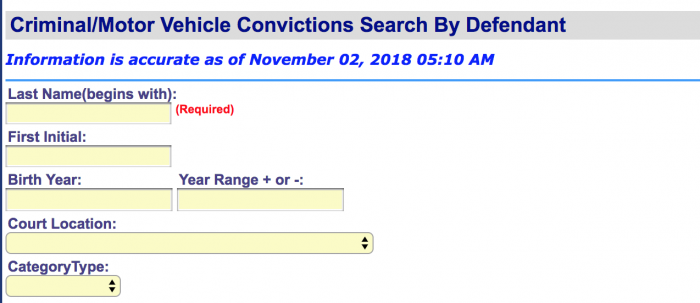
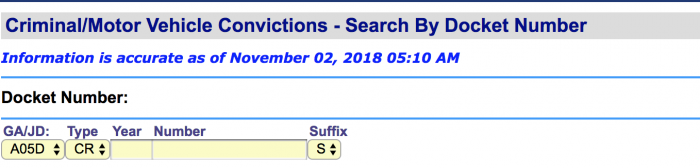
The State of Connecticut Judicial Branch maintains all types of criminal records, including conviction records and vehicle-related conviction records. You can search in two ways, including by the name of the defendant or the case number.
Search for Criminal Records by Defendant Name
You can search in two ways, including by the name of the defendant or the case number.
Search for Criminal Records by Defendant Name
 Search for Criminal Records by Docket Number
Arrest Records and Arrest Warrants
Searching for a pending arrest warrant in the State of Connecticut? If you are looking for yours or another person’s warrant for arrest in the State of Connecticut, you can search the State of Connecticut Judicial Branch outstanding warrant database. Why search for a pending arrest warrant in Connecticut? There are many reasons you might want to search for pending arrest warrants in the State of Connecticut. For example:- If a person violated parole or probation
- If a person failed to appear in court
- Any orders to incarcerate that have not been fulfilled.
Court Records
Are you searching for court records in the State of Connecticut? The State of Connecticut Judicial Branch makes it easy for you to search court records. You can search for criminal court records, motor vehicle violations, and civil court cases online. You can also search for Supreme and Appellate Court Case Records. There are two ways you can search for criminal or motor vehicle records in the State of Connecticut. The first is via the location of the court, and the other way is via the defendant’s name. Search by the Court Location in the State of Connecticut. Search by the Defendant’s Last Name. You can also search for pending court cases in the State of Connecticut through the state’s Judicial Branch. Search for Pending Criminal or Motor Vehicle Cases by Defendant Name. Search for Pending Criminal or Motor Vehicle Cases by Docket Number. Search foe Criminal or Motor Vehicle Cases by Attorney or Firm. If you are having any trouble finding out where the court in Connecticut is located, then you can also look at the list of all state courts by geographic area. A full list of Connecticut Judicial District Courts is also available for you to search. Why search for court records in Connecticut? There are several reasons why you may need to access court records in Connecticut. For example, you might need to learn more about case history for research or for your own legal appeal. In Connecticut, you can also search public records such as proceedings of a Grand Jury.Background Checks
Employers often want to conduct background checks on prospective or current employees. However, it is illegal in the State of Connecticut to discriminate against an employee or prospective employee on the basis of a criminal background check. Connecticut has a strong policy advocating for the rights of ex-offenders to re-enter the job market once they have served their debt to society. Of course, there are certain important exceptions to this rule, mainly when an individual might pose a threat to coworkers, clients, or the general public. Generally, though, background checks cannot be routinely or arbitrarily used. Know your rights when it comes to employer background checks. Background checks are perfectly legal and permissible in some situations, especially for jobs in the government and public service sectors. Some positions may also require background checks to protect the safety of the public: jobs that are in education, childcare, healthcare, and medical services are examples of situations where employers may conduct criminal background checks on prospective employees. Connecticut law also holds that when an employer conducts a background check, that information must be held confidential—only for use by that company’s human resources department. Criminal background checks are actually required by Connecticut law for some professions, such as being a school coach. However, your request for background checks will be denied if you are seeking information that has been expunged. Examples of expunged records would include juvenile records or law enforcement records for charges that did not result in a conviction. Sometimes, landlords and property owners may want to conduct criminal background checks. While property owners do have the right to conduct criminal background checks for this purpose, Connecticut law does attempt to balance the interests of protecting the rights of ex-offenders in finding suitable housing with the rights of property owners.Inmate, Prison, and Jail Records
You can search for any person currently serving time in a Connecticut prison. The best way to search for an incarcerated individual in the state of Connecticut is to go directly to the Connecticut State Department of Correction website.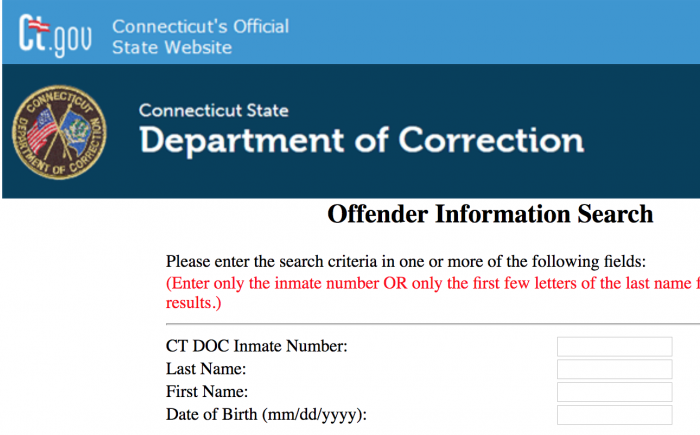 Here you can search for an offender by inmate number, name, and date of birth.
Families and friends frequently want to know inmate information related to someone close to them, either for a visit or simply to find out the location and length of their term.
Victims may also want access to Department of Correction public records.
If you are having trouble locating an offender in the state of Connecticut, the Department of Correction maintains a list of suggestions for a successful inmate search.
Here you can search for an offender by inmate number, name, and date of birth.
Families and friends frequently want to know inmate information related to someone close to them, either for a visit or simply to find out the location and length of their term.
Victims may also want access to Department of Correction public records.
If you are having trouble locating an offender in the state of Connecticut, the Department of Correction maintains a list of suggestions for a successful inmate search.
Driving Records
You may want to access your own or another person’s driving records in the State of Connecticut. Driving records in Connecticut will contain information such as driving history. You may need this information for insurance purposes, or to dispute an insurance premium. Search the Connecticut Department of Motor Vehicles for driving records. In the State of Connecticut, you can even search for pending traffic tickets. All you need is the traffic ticket number. To search for pending traffic tickets, just use the Centralized Infractions Bureau, which is part of the State Connecticut Judicial Branch.
In the State of Connecticut, you can also search for public records related to automobile accidents that have been registered with the state police. This type of information can be useful in several situations. For example, if you are hiring professional drivers, you need to know their driving history.
However, the Department of Emergency Services and Public Protection in the State of Connecticut also maintains public records related to automobile accidents that occur.
To search for pending traffic tickets, just use the Centralized Infractions Bureau, which is part of the State Connecticut Judicial Branch.
In the State of Connecticut, you can also search for public records related to automobile accidents that have been registered with the state police. This type of information can be useful in several situations. For example, if you are hiring professional drivers, you need to know their driving history.
However, the Department of Emergency Services and Public Protection in the State of Connecticut also maintains public records related to automobile accidents that occur.
 Search for simple vehicle accidents in the State of Connecticut. If the accident occurred within the last ten days, you can use this website to search the public records.
After 30 days, search for accident and investigative reports related to a vehicle incident in the state of Connecticut.
Search for simple vehicle accidents in the State of Connecticut. If the accident occurred within the last ten days, you can use this website to search the public records.
After 30 days, search for accident and investigative reports related to a vehicle incident in the state of Connecticut.
Sex Offender Records
The State of Connecticut Department of Emergency Services and Public Protection, in conjunction with the Division of State Police, manages a statewide sex offender registry database. Anyone can search the sex offender registry in the State of Connecticut, but keep in mind that the information kept in this database is maintained to protect you and your family. It is in the public’s best interest to have freedom of information but not to allow for harassment or harm to an individual whose name appears in the registry. Therefore, using the information in this database to harass another person is considered a criminal act.
Property Records
In the State of Connecticut, property records are kept locally. Property records may include information like titles and deeds. However, you can find a list of all counties and municipalities in the State of Connecticut and perform a property records search accordingly. Likewise, all Connecticut assessor and property tax records are stored locally.Unclaimed Property
Many people in the State of Connecticut do not realize that they or their loved ones may have unclaimed property you are entitled to keep. Examples of unclaimed property in the State of Connecticut includes:
- Bank accounts
- Stocks and bonds
- Safety deposit box contents
- Insurance policies
- Mutual Funds
- Uncashed checks
- Wages
- Search for unclaimed property in Connecticut by the person’s name.
- Search for unclaimed property in Connecticut by the property identification number.
Missing Persons
The State of Connecticut Division of Criminal Justice maintains a comprehensive database of cold cases that remain open, as well as unsolved crimes and missing persons incidents. Missing persons cases may involve both adults and children. The Office of the Victim Advocate in the State of Connecticut also offers information about missing persons, and how you can search for names.
Voter Registration
There are several ways to search the voter registration records in the State of Connecticut. The Connecticut Office of Secretary of the State is in charge of voter registration. Therefore, you can search the Office of Secretary of State Voter Registration Lookup. You can search the voter registration database by name. Search the voter registration database by address. Or even search the voter registration database by the person’s date of birth.Vital Records
In Connecticut, vital records are kept by the state’s Department of Public Health. Vital records in the State of Connecticut include birth records (birth certificates), marriage records, divorce records, and death records or certificates.
You can easily search for any vital records you need in the State of Connecticut.
Until recently, you would have to contact the local municipality to find the public records you are looking for. However, now the state of Connecticut does maintain a statewide vital records database you can search.
If you prefer, you can search directly with a local municipality in the State of Connecticut.
The advantage to searching directly with the municipality is faster processing times.
However, it is easy to search for vital records in the State of Connecticut using the authorized third party database VitalChek.
Vital records in the State of Connecticut include birth records (birth certificates), marriage records, divorce records, and death records or certificates.
You can easily search for any vital records you need in the State of Connecticut.
Until recently, you would have to contact the local municipality to find the public records you are looking for. However, now the state of Connecticut does maintain a statewide vital records database you can search.
If you prefer, you can search directly with a local municipality in the State of Connecticut.
The advantage to searching directly with the municipality is faster processing times.
However, it is easy to search for vital records in the State of Connecticut using the authorized third party database VitalChek.

Birth Certificates / Birth Records
Although birth records are technically considered public records, access to birth records and certificates is restricted to safeguard your privacy. Only you and other eligible persons, as outlined in C.G.S. §7-51, can access or receive copies of your birth certificate. Who is eligible to receive birth records? Generally, only you and your immediate family can access these confidential records. There are some qualified government agencies that may be entitled to access birth records in the interests of public health or safety. You can contact the Connecticut Department of Public Health to access birth records.Marriage Certificates
Marriage records are also considered public records, but access is still limited. For example, Connecticut law prohibits people from accessing personal identifying information such as Social Security Numbers, from your marriage certificate. Search for marriage certificates in the State of Connecticut by contacting the Department of Public Health.Divorce decrees
While birth, marriage, and death records are kept by the Connecticut Department of Public Health, divorce records are court records. Therefore, you need to search for divorce records in Connecticut by contacting the appropriate superior court.Death Certificates
Death certificates may be needed for legal or research purposes. Anyone can access death records in the State of Connecticut, but personal identifying information like Social Security Number will be omitted. You can search the Connecticut Department of Public Health for death certificates.Other Vital Records
Other vital records in Connecticut are usually maintained by the Department of Public Health. For example, fetal death records, civil union certificates, and adoption records are all available through the Department of Public Health.Wills
In the State of Connecticut, wills are processed in the state Probate Courts. You can search for probate cases and wills filed in the state of Connecticut from 2011 onward. Probate courts in the State of Connecticut cover all sorts of legal issues related to families and control over family estates.Conclusion
Accessing public records in the state of Connecticut may be easier than you think! Open government and freedom of information allow a democracy to function properly, empowering citizens with information. At the same time, sensitive personal data is not something that you want anyone to access or misappropriate. Therefore, Connecticut state laws and federal laws do prevent unrestricted access to your personal records, even when those records are maintained by the state or a federal agency. Know your rights as a citizen to access public records.'
Search Public Records